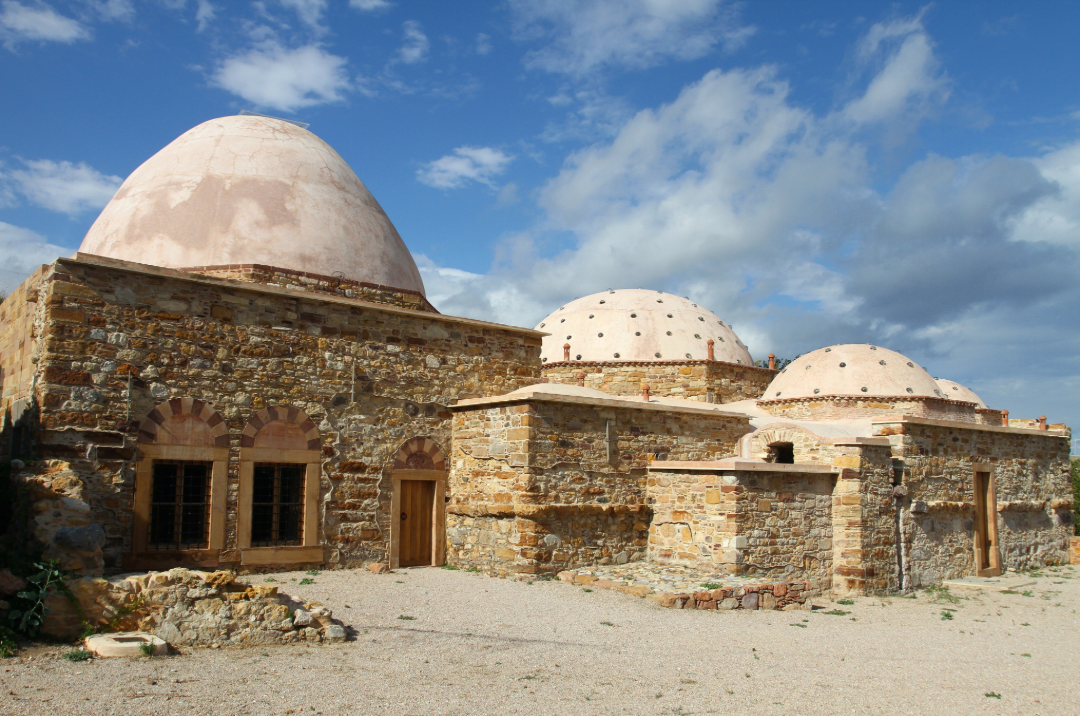


Castle of Chios is one of the most important medieval monuments in the Aegean, a living citadel that has guarded Chios Town for over a thousand years. More than just a fortress, this impressive complex includes residential neighbourhoods, churches, Ottoman monuments, medieval gates and centuries of layered history. With its vast stone walls and strategic seaside location, the Castle continues to stand as a remarkable testament to Byzantine, Genoese and Ottoman influence on the island.
The origins of the Castle date back to the 10th century, when the Byzantines constructed the first defensive enclosure to protect the town from naval raids and pirate attacks. Over time, the structure expanded, especially during the period of Genoese rule between the 14th and 16th centuries. Their architectural contributions shaped much of what visitors see today—massive walls, strong bastions and interior buildings designed to support both military activity and civilian life.
Castle of Chios is unique because it was not only a military stronghold but also a functioning residential settlement. Within its walls, everyday life unfolded for centuries—families lived, merchants traded and soldiers guarded the island’s valuable port. Even today, parts of the Castle remain inhabited, giving it a vibrant atmosphere unlike many abandoned fortresses in Greece.
Visitors enter through one of the castle’s fortified gates and are immediately transported into an atmospheric labyrinth of narrow lanes, stone buildings and historic monuments. One of the most notable landmarks inside the citadel is the Church of Agios Georgios. Originally a Byzantine church from the 10th or 11th century, it later became the Genoese church of San Domenico. Giovanni Giustiniani—renowned for his heroic defence of Constantinople—was buried here.
During the Ottoman period, the west section of the church was converted into the Eski (“Old”) Mosque by Piyale Pasha after the Ottoman conquest of Chios in 1566. After an earthquake in 1881, the building underwent repairs before eventually becoming the modern Orthodox church of Agios Georgios, blending centuries of cultural influence into a single structure.
To the north of the castle lies a well-preserved Ottoman bath complex. These traditional hammams feature typical vaulted roofs, domed chambers and stone basins—offering a fascinating look into Ottoman daily life. Nearby is the Kria Vrisi cistern, a large semi-underground water reservoir divided into four sections by a cross-shaped vaulted roof supported by eight stone pillars. This structure once supplied water to the entire castle and remains an impressive example of historical engineering.
The size and variety
Is the Castle of Chios still inhabited?
Yes, parts of the Castle remain residential, giving it a unique lived-in atmosphere.
Are there entrance fees?
Most areas are free to explore, though some restored sections may charge seasonal fees.
What can I see inside the Castle?
Ottoman baths, the Church of Agios Georgios, medieval gates, fortification walls and historic cisterns.
How close is the Castle to the port?
The Castle borders the main Port of Chios and is only a short walk from ferries and the town centre.
The Castle of Chios is located next to the main Port of Chios, making it easily accessible for visitors arriving by ferry or staying in Chios Town. Its eastern walls run along the coastline, offering scenic sea views and a short walking distance to the centre of town.
Find more things to see and do in Chios here.


One of the lesser known regions of Greece, Eastern Macedonia and Thrace has many attractions that make it an appealing destination for a holiday.